
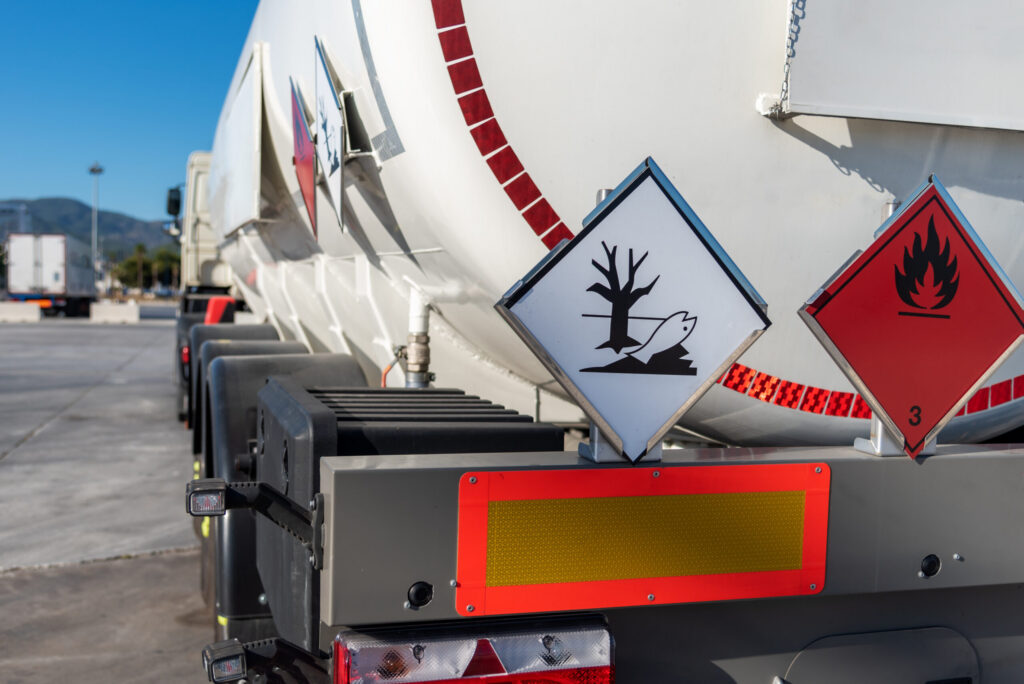
When we think about transporting items by road or sea, we often take the safety of the journey for granted. However, certain materials pose a direct risk to health, safety, property, and the environment if managed incorrectly. These are officially classified as Dangerous Goods.
The United Nations (UN) organises these hazardous materials into nine distinct classes. If your business is involved in moving any of them, you are bound by a complex web of legal responsibilities.
The 9 Classes of Dangerous Goods
To ensure safety across global supply chains, dangerous goods are categorised into nine major hazard groups:
- Class 1: Explosives
- Class 2: Gases
- Class 3: Flammable Liquids
- Class 4: Flammable Solids
- Class 5: Oxidising Agents and Organic Peroxides
- Class 6: Toxic and Infectious Substances
- Class 7: Radioactive Material
- Class 8: Corrosive Substances
- Class 9: Miscellaneous
Different modes of transport require vastly different rules. In the UK, transport by road is strictly regulated by The Carriage of Dangerous Goods and Use of Transportable Pressure Equipment Regulations 2009 (CDG09), which implements the international ADR framework. Meanwhile, maritime transport is governed by the International Maritime Dangerous Goods (IMDG) Code.
The Legal Requirement: What is a DGSA?
Under CDG09, if your business regularly handles, packs, loads, or transports dangerous goods above certain thresholds, you are legally required to appoint a certified Dangerous Goods Safety Adviser (DGSA).
Your DGSA is responsible for monitoring your compliance, training your staff, investigating any transport-related incidents, and producing a mandatory annual audit to ensure your transport operations remain fully compliant with UK law.
The Class 7 Problem: Why Standard DGSAs Often Fall Short
A common issue businesses face when dealing with logistics is finding a DGSA qualified to advise on Class 7 (Radioactive Material).
Many general transport advisers will confidently consult on flammable liquids or corrosive substances, but explicitly exclude Class 7 from their services. Why? Because radioactive substances require specialist consideration regarding:
- Complex Packaging: Choosing and verifying exceptional packaging types based on activity levels.
- Strict Radiation Emergency Plans: Developing specialised emergency response frameworks in accordance with HSE guidelines.
- Shielding and Segregation: Preventing radiation exposure to drivers, the public, and adjacent cargo during transit.
- CDG Derogations: Navigating specific UK-only exemptions and national variations.
Because the risks associated with ionising radiation are so distinct, additional, advanced technical training is necessary to manage radioactive cargo safely.
How HTSL Group Optimises Your Transport Compliance
We bridge the gap by offering a specialised DGSA service focused explicitly on Class 7 Radioactive Material.
Our fully qualified advisers are on hand to provide year-round technical guidance, help you design robust transport protocols, and perform your mandatory annual compliance audits. Crucially, our expertise covers transport logistics for both road and sea (IMDG) networks.
Bespoke Transport Training for Your Workforce
In addition to consultancy, we can deliver fully tailored safety training programmes for your personnel involved in the logistical chain. Our modules can be customised to your exact operational requirements and cover:
- Identification & Classification: Correctly identifying Class 7 materials and their specific UN numbers.
- Packaging Selection: Ensuring the correct choice of industrial or Type A/B packaging.
- Marking and Labelling: Compliant placarding and labelling of packages and transport vehicles.
- Documentation: Completing accurate Dangerous Goods Notes (DGNs) and consignment details.
- Segregation & Emergency Actions: Best practices for load segregation and implementing Radiation Emergency Plans.
Get in Touch with Our Specialists
Don’t let transport compliance put your business at risk of regulatory penalties. Whether you need a formal DGSA appointment or specialised training for your logistics team, HTSL Group provides the industry-leading expertise you need.